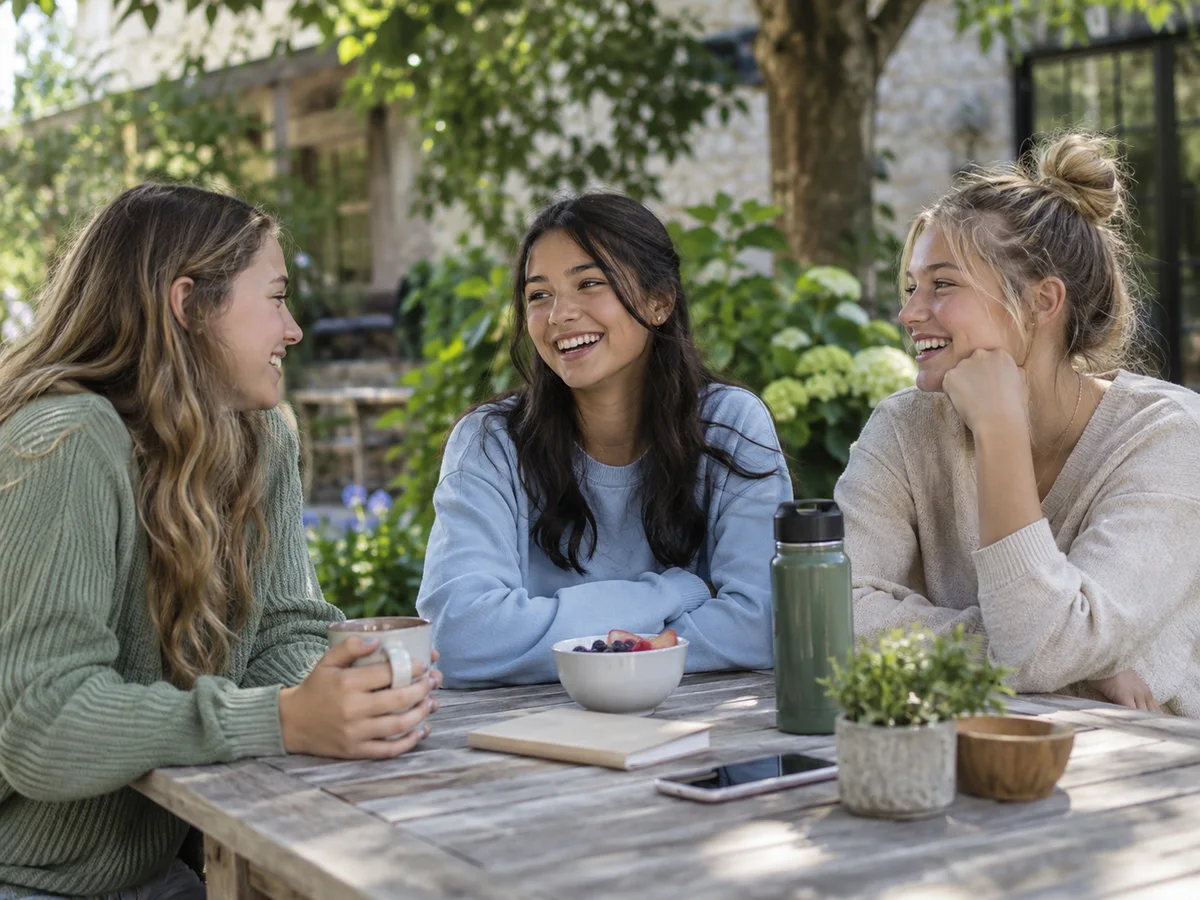
A healthier digital space for girls
Social media can amplify comparison, loneliness and pressure at a time when girls are still developing confidence and self-understanding. Ila and Jessica explain how U4U creates smaller, grade-based communities built around mentorship, daily activities, mood and sleep check-ins, and purposeful connection.
The conversation also explores prevention, the developing teenage brain, parent involvement and the importance of giving girls support before challenges become crises.
Key takeaways
- Why social comparison can affect confidence, belonging and self-worth.
- How small, grade-based groups can help girls form meaningful connections.
- How daily activities, mood check-ins and sleep check-ins encourage healthier habits.
- Why prevention and early support matter before challenges become crises.
- How parents, schools and health care organizations can support teen emotional wellness.
- What developing teenage brains need from adults when navigating online pressure.
- How mentorship gives older girls opportunities to lead and support younger girls.
About Ila and Jessica
Ila Panik Marchetta
Ila is the founder and CEO of U4U. Her background includes entrepreneurship, innovation, growth and behavior change. Her long-standing interest in empowering girls led her to develop a scalable digital platform focused on confidence and connection.
Jessica Etchevers
Jessica is a co-founder and COO of U4U and a school psychologist who has worked with students from kindergarten through 12th grade. She brings clinical and educational experience to the platform and is also a parent of children within U4U's target age range.
Chapters
- 00:00 Introduction and the need for healthier digital spaces
- 01:30 Meet Jessica Etchevers and Ila Panik Marchetta
- 04:39 What makes U4U different from traditional social media
- 06:05 How the U4U app, houses and daily activities work
- 10:00 Expanding access through schools, health care and parents
- 15:00 What genuine self-care looks like for teens
- 19:04 A school psychologist's perspective on early support
- 24:02 Understanding the developing teenage brain
- 27:02 Workshops and ways families can discover U4U
- 31:01 Mentorship and leadership opportunities for older girls
- 34:00 The guests' personal philosophies
- 36:19 Closing thoughts
Resources mentioned
- Visit the U4U website
- Explore U4U for Teens
- Search for U4U in the Apple App Store
- Visit Baby Steps Nutrition
Frequently asked questions
What is U4U?
U4U is a digital wellness and connection platform designed for tween and teen girls. It combines small peer groups, mentorship, daily personal-development activities and wellness check-ins.
How is U4U different from traditional social media?
U4U is designed around support and personal growth instead of popularity metrics, appearance-based comparison and endless scrolling. Its goal is to help girls feel connected without adding more online pressure.
How does U4U support teen emotional wellness?
The platform encourages consistent habits through mood and sleep check-ins, wellness activities, supportive peer groups, workshops and mentorship. It is intended as an early-support and prevention resource, not a replacement for professional mental health care.
What can parents do to support teenage girls online?
Parents can stay curious, discuss what their daughters see online, create regular opportunities for offline connection, model healthy technology boundaries and seek professional support when emotional or behavioral changes become concerning.
Is U4U only for girls already using social media?
No. The founders explain that introducing girls to healthier digital connection before they become active on mainstream social media may help them build stronger habits and expectations.
Full Episode 156Read the transcriptExpand
00:00Welcome back to the Baby Steps Nutrition Podcast. Today, we're diving into a topic that's more important than ever. How can we help girls grow up with confidence, resilience, and a healthy relationship with themselves in a world shaped by social media? My guests are the founders of U4U, a platform created to empower girls through mentorship, meaningful connection, and daily habits that support emotional well-being. Their mission is to create a digital space that helps young people feel seen, supported,
00:35and equipped to thrive, rather than adding to the pressures so many experience online. I'm thrilled to welcome Ila Panik Marchetta and Jessica Etchevers. Together, they've combined their experience and passion for youth development to build a platform focused on confidence, connection, and positive mental health. I can't wait to learn more. Let's get started. Welcome, ladies. Good morning, ladies. So today, we are discussing this fabulous platform that I came across, of which you are the founders of U4U.
01:13And we're just going to get right into it. And I want you to tell our audience everything about this platform and what inspired you to create it. Sort of, we'll talk about all the challenges behind it and your mission and goal of where you want this to drive towards. So welcome. So maybe Jessica, we'll start with you if you can tell us a little bit about yourself. Sure. So my name is Jessica Etchevers. I'm the co-founder of U4U. I'm actually a school psychologist by career.
01:43I worked with kids from kindergarten through 12th grade in a variety of different educational settings and different capacities. And then I met Ila and kind of took a little bit of a turn in my career. And helped with, well, everything in a startup, but a lot of the clinical side of things, plus everything else that we need to do together. So, and I also have three kids of my own, ages 10 through 15. So my own kids are really right in the sweet spot of this demographic that we're trying to really help.
02:18So, yeah. Thank you. And Ila, a little bit about you. Sure. Or a lot about you. I know. But yeah, so I mean, I actually had, sometimes I use the word calling, which sounds cheesy, but like an inclination to work in this space when I was a teen girl myself, I started to think about the fact that I wanted to do something in my future that would make a difference. And then as is the same now, I focused in on the fact that supporting teen girls would
02:50make a massive difference because girls go on to lead their families. They go on to lead in our communities and our schools. And with more females leading at the highest levels, you know, there's a lot of statistics about how much improvement to all of the issues that kind of plague us there could be. So at a young age, I actually had the inclination to support to work in empowerment space for girls, for teen and tween girls. And I went on to study business, help build businesses, work in entrepreneurship with
03:24my degrees, went for a master's degree in London and began working in innovation and growth. And this whole time I'm thinking about girls and I'm coaching ballet, coaching sports and teaching ballet and doing a lot of side projects where I am working with girls in whatever capacity allows me. And then I did launch a side project in early 2000s as an in-person version of U4U and tested the idea out. I kind of didn't see the scalability and plus life changes, family starting, moving
03:55back to the U.S. I decided to put the idea on hold, but fast forward, you know, I guess it's been really exciting. I mean, I know we'll talk about more details of why we started it and when we did and so forth. But, you know, it was just, I built a lot of skill in behavior change and innovation and growth. And it was really exciting to take all those skills, you know, from working with Visa or Unilever, these big companies and helping them create innovative ways to solve problems and apply it to a problem or an issue that I'm really passionate about.
04:26And that's kind of what I was able to do is just bring years and years worth of experience with innovatively solving problems and applying that skill towards an issue that's a pretty important issue. Yeah. And right away when I first found out about your story, of course having a girl who's 14 and I've worked in pediatrics. So of course I've seen it all. And you know, what I love about your work is some might call it a social media app, but it's really an anti-social media app, right?
04:56And a lot of what you focus is on prevention where a lot of things now. focus on after the fact. So can you tell us a little bit about what makes your app so unique and why the focus is what it is? Yeah, I don't know. Do you want to jump in Jessica? Sure, yeah. So as we all know, you know, social media can be highly toxic, is highly toxic to most users, particularly adolescent girls,
05:28because of its very nature, because of its addictive nature, because it draws so much comparison, so much just the constant, you know, what's what do you have? What do you look like? Where did you go on vacation? All of that. And that particularly for tween and teen girls can actually be much more concerning and damaging than even to teen boys. It just hits girls differently as we've all kind of learned over the last couple of years. So the U4U app is a place where
05:58girls can go that it's just about what's on the inside, not what's on the outside. So the way the app works is that girls are when they come on board, they're put into a house and they're organized by grade. And it's a small group, 20 to 30 girls in their same grade from across the country. So it's sort of like a little mini sorority. And within that house, there's a house lead who serves as sort of a mentor or big sister. And that house lead is a college
06:30student or a graduate student that's in psychology, cognitive sciences, that type of thing. So already within that house, they have a connection, which is something that girls are missing, particularly on traditional social media. They also do one to three minute daily challenges, which are behavior learning. But they're quite fun, their quizzes or prompts or take a photos on the outside. And the whole point is to get them to do something that's good for themselves. And not just here's the new bag I got. Here's my
07:04new fit for school. It's about go outside and snip a branch and put it in a vase and bring it into your house and enjoy the outside. So they do that. And then they do mood and sleep check ins, which helps with emotional regulation and sleep tracking, which we have learned from our sleep specialist is actually one of the most important factors. It's not necessarily quantity of sleep. It's actually much more on sleep routine. So that helps with that. And then they can message their big sister if they need help with something, or if they have a question or something like
07:34that. And they can also get a sister within the house kind of serves as a pen pal or that one direct connection with a peer. In our pilot users spent about an average of six minutes per day on the platform. And the nature of it is that there is no capability for endless scrolling. There's only so much they can do. And then they have to be done for the day. And some of the feedback that we got when we were on the pilot was that girls really liked the platform itself. But what it
08:04served for some girls was actually a place they could go when they were scrolling on Instagram or something, and kind of use it as a palette cleanser. And it kind of took them out of that mindset to do something positive for themselves. And then they could kind of move on. So that's it in a nutshell. Did I miss anything, Eila? I think that sounds great. And yeah, I guess the only thing I was going to kind of add to that is, you know, slightly like parallel conversation is just about how it's different. And, you know, we
08:34have had other people say this is almost like the remedy or the cure to social media. But I think like kind of leading into my past conversation and speaking about the work that I was doing in innovation and growth, something that we, you know, do in every project in innovation growth is look at all angles of the situation. And so when when we were shaping the app, it's like, well, what's causing the problem, you know, it's like, okay, social media, busy parents, you know, not enough support in schools, you know, there's a few things, but
09:04definitely social media being one of them. And then it's like, well, wait, why, why is it causing a problem? Like, wow, the girls are really drawn there. They're spending huge amounts of time there. What is it that they're getting there? Why are they going there? Like, so we did all this work and you know, all that kind of looking at what's going on in the market, looking what other organizations are doing. And, you know, so it wasn't just like, Oh, let's just do this. Let's oh, here's an idea. Let's do this. It was more, it's very purpose built app, like, you know, understanding what the girls are seeking from social media, and trying to deliver the
09:37good parts of that, because there are some benefits to social media, or there is some benefit to being able to use technology to connect people and deliver content that can help them lead a better life, you know, so there's a lot of opportunity there. So what we kind of tried to do is just take out the bad parts, keep the really good parts and then just, you know, really shape it so that it is effective that it can get to girls in the time when they most need it so it can get to girls who might not otherwise be able to get support anywhere else or find connection or belonging anywhere
10:10else so I think yeah those two sides of the story of what it is and then how we kind of how and why we built it as as we did kind of come out in those two explanations very cool and we all know that the three the top three instagram snapchat and tik tok are very powerful I mean they're influencers and themselves right so it is very hard to compete with those apps and I think a lot of kids are bright they know that those apps affect them but when they're using an app
10:42like U4U do they develop an awareness of how they're affected by those apps yeah I would say oh we absolutely I mean Jessica we definitely develop content in that space don't we um there was just one other thing I'd say about that which is it is very hard for us to compete with those apps and technically um which is why we're exploring partnerships with schools and health care organizations and parents so that we can try to um pardon the the background dog barks every now
11:12and then he's excited too yeah um but which is um why we're looking at forming those other partnerships and which is also why we appreciate some of the new legislation that comes in that's you know putting on age limits and so forth because those different regulations really make a space for an app like ours um that said we have had a lot of girls use the app and say like I'm happy that I have somewhere where I can go when I kind of want to take a bit of a like a mind break that's not instagram or snapchat you know it's like an
11:45alternative option it's giving them a choice of somewhere else to go um so yeah there's I think a lot of angles to that yeah I'm going to go ahead Jessica I was going to say I would I would add to that within some of the challenges we've kind of done little videos we've used uh so we had a great group of marketing interns and they made little sort of like you know almost TikTok or Instagram style videos of themselves but instead of it being like oh my haul or whatever
12:15it's like uh how do you reduce stress I stretch for one minute and then she kind of walks them through stretching so it has that feel like it felt like a little bit of a social media video but it's like really positive and it's slower slowed down so that it's you know not so much sensory overload but it has the feel so we try to do that in our content to make it feel like that but it's much more positive and beneficial to the to the girls so yeah and what I love is as a parent as a health care provider you know there's so much blame on parents while your
12:50kids like this because you don't set enough limits or this is what's happening in the world because adults are not being responsible enough to step in and so I know I've seen it both ways how hard that is because like we just discussed there's so much competition and noise and unless you're able to be on top of everything 24 hours a day and live your life and manage your obligations and responsibilities I mean it's impossible right so that's the honest conversation that we need to have but what I love is when people come up with well how do I
13:21help the situation right and that's what we need more of we know that there's a big problem there's no doubt about that there's a lot of talk headlines about these are the problems that the kids are experiencing okay but as parents health care providers how do we help them and how do we make the situation better and this is where you guys come in and I absolutely love that I mean yeah these are real life and parents can use that and then help their kids too in the process it's not just for kids it's for everybody right and then we do have our parents
13:51subscription and that really aims to sit beside you know it sits besides our app and it it's purposely built for the parents to share insights based on the age of their their young person but also gives them insights into what their young person is engaging with that week or that those you know couple of weeks so that they can bring it home and do some things there because I mean you know as all of us know being parents it's so busy and it's like sometimes I don't know what words to use or I don't know oh yeah that would be a good activity for right now and
14:22you know so there's just that little bit of support there for parents as well and then on the side to what you were just alluding to as well it's I think you know as both of you know better than I do as clinical experts but at this stage when the girls are trying to pull away from their parents giving them somewhere where they can go to work on their or start beginning to work on their personal development journey on their own and investing in themselves and recognizing that that's an important part of life to take that ownership and do it
14:52in a way that suits you I think you know that's another part of the app that ends up being really beneficial at this age of the girls lives Yeah, and I think there's so much focus on TikTok about self-care and makeup and skin care But I think the real self-care is stepping away from all of that and just taking a break when you feel so overwhelmed Absolutely. Yeah, and I can't help to jump in on that Con our point as well and just speak to the fact that when we built U4U We built it based on four pillars and so our four pillars are self connection culture and environment
15:27so self is you know my individual strengths and wellness and and Mental and physical fitness and connection is being able to connect with others Understanding relationships managing conflict all that goes into connections and then culture Recognizing where we've come from celebrating the beauty finding our belonging in that appreciating others empathizing with others learning growing from and then also environment having this connection with nature and I think you know You see a lot of other things out there about self-help or wellness and this and it's very focused on that first pillar
15:59Just self and so we're really excited at this stage That's so important in their development to give these girls You know a really holistic view on on what personal development means You know, it doesn't only mean making sure that I'm you know Taking care of myself, but it also means making sure that we're having healthy relationships and and finding those connections and reaching out to people and seeing what kind of people we want to be spending our time with and you know recognizing our family and our heritage and then spending that time outside, so yeah I think it's a whole lot more to than just the shallow version of wellness or
16:34Well-being yeah, yeah, and that's a hyper connected piece of this right that everyone is Connected but we're under replenished because of that so like I said, it's all very superficial So well said. Yes. Yep. Yeah, and talk to me about some statistics that you found alarming in doing your research in launching this app Go for it. I'll you have these down. I love
17:04Yeah, I mean the main thing That was alarming, you know when we first like kind of started getting very serious about building U4U is kind of post COVID, you know 2022 2023 and you know the Surgeon General is starting to report how teens have a mental health crisis You know, we started looking into the statistics more and it's like teens have it hard all teens do but teen girls on every single
17:34statistic are at least 50% you know Poor from a wellness standpoint the boys if you look at the rates of depression amongst girls teen girls versus boys It's about 50% higher rates of depression and same with suicidal ideation and and self-harm and Body images around 70% higher, you know, and there is you know There's a lot of conversation around that if boys are being accurate accurately reported and there's all those topics But when you look across the board, it's very clear that
18:07Girls are having a hard time and then you even look further and you know I was like well How is it compared to other groups of people in the country? You know seniors or because there's a lot of people having a hard time, especially post COVID and so forth and it's like wow Adolescent girls are the demographic experiencing the most severe mental health crisis of any group of people and you know over time we'd heard different conversations around this and the one that really stuck in my head is the fact that These are the same group of people that are going to be delivering 100% of our next generation
18:38Like these young girls will be mothers, you know And and what does that mean for a future if these young ladies are not, you know Mentally well and not not feeling strong and capable. So I think those statistics are the ones that really drive us every single day Yeah, and Jessica talked to me about as a clinician having worked with kids What are some of those life-alive moments or stories that have stuck with you about some of the things they've shared that they were struggling with? Yeah, so I actually worked in
19:08High school program for pretty severely emotionally disturbed kids And we actually had like five counselors on staff because their needs were so great But what really struck me is in conversations with some of our health care connections You know, I I witnessed a lot. I also worked with foster youth. So I witnessed a lot of like very very acute and You know, very very high need high pathology level kids
19:40But what I think struck me most is How did they get there? What what was given to them? What support systems were in place for them way back? You know at the beginning and the thing that struck me most is there wasn't very much, you know and so In our conversations with our healthcare people, what they like most about what we're doing is the preventative nature of it. We can start a little bit early. We are our youngest, our youngest age is 11.
20:14And we can get in there and give them these tools and supports really young so that when they're 17 and having these really high levels of acuity and this really pathological behaviors, we have started and given them tools way back here versus oh, wow, you have a lot of issues and a lot of significant things we need to work through and now it's too late. So the statistic that, going back to the statistics that Isla always likes to mention is 50%,
20:44or correct me if I'm wrong on these Isla, 50% of mental illness for women starts at age 14 and 75% by age 18. So if we can get in there early and give them some tools, we have a chance of really helping them have a brighter, better future. So that's what struck me when I was just looking at what I saw, it was that that train had already gone down the tracks and I always wanted them to have something
21:14to start with when they were younger, some tools and supports when they were younger. Yeah. Isla, do you have anything to add there? I mean, I think that's, yeah that's, I think those are the main issues is like, girls are being hit really hard, they need something dedicated. There aren't, I guess the only other pieces almost on the business side is there's just not solutions out there. Sometimes people say, well, maybe this app could be mimicked and we're like, that would be great if there were more solutions for this demographic because any of the wellness pieces out there,
21:47they're like almost all crisis based. So there are solutions for once the girl has had a crisis and then there aren't very, very few and definitely not kind of up to date and engaging. We continue to look for them and if somebody found one and said, well, what about this one? We would love to look into it, but there's not too many solutions that are kind of preventative, dedicated for girls and trying to seek to meet them where they are in their life in a way that fits with their life. So.
22:17Yeah, and it's really within the health and wellness space, right? More so than the social. Yeah, I mean, the thing is like if we're gonna engage this demographic, we can't really create a product or a solution or something that is not meeting them where they are, not something that they're gonna want to engage with. So, and what are the things they wanna engage with? They wanna engage with like a social media type. There's something there that they've been missing. From a lot of the research we did,
22:49we kind of narrowed everything down to the fact that teen girls are feeling anxious, lonely, and hopeless. Much of that is from the social media. Anxious, they've got school, they've got all these expectations as girls and they're always feeling like they're never good enough, they're always being left out of something, they can never keep up, they can never be the most... A lot of anxiety, sports, so competitive. And then the loneliness, it's like as you mentioned earlier, they're so connected, but yet there's no real connections. And then the hopelessness,
23:20they're exposed to so much climate change, school shootings, all these things. And Jessica always brings this into our conversations, yet at a stage when their brains aren't really ready to deal with them and they don't ever see the fact that there are solutions for these problems. They just get problems to a point where they're like, I just wanna give up. So it's like we're meeting in them where they are and we're trying to be the anti, give them that tools to deal with that anxiety, give them tools to find connections and belonging and then give them hope and inspiration
23:53and belief and cheerleading to say like, there's so much we need you out there. Go, fulfill your potential. You can do so much, so yeah. Yeah, and Jessica, tell us about the teenage brain. What's going on in there? What do adults need to know? Because sometimes we think they're just younger versions of adults and that is far from the truth. So tell us what goes on in the mind of a teenager. So this is such an interesting topic because it's actually different even between teenage girls and teenage boys, right?
24:25They develop so differently. The one thing I always throw and I feel like a lot of people know this already is that your frontal lobe, which regulates impulse control and attention and so many of those things, we now know is not fully developed until your mid-20s, 24 on the early end. Now they're even saying could be closer to 25 or 26. So I agree with you that we think, come on, you see them make a decision or something and it's so frustrating as parents, you're like, how do you not understand that that is not a good decision?
24:56And the truth of the matter is their brains aren't able to. yet. That part of their anatomy and physiology truly is not fully developed yet. So we as parents need to really understand that because that is such obviously an important part of how we go through our lives. You know, you have to have ability to impulse control. You have to be able to attend. You have to have those executive functioning pieces in place to be a successful adult. And it just isn't there yet. They don't have it. They're not being willful. They're not,
25:30you know, trying to annoy you. They're just don't have the capability. And then what we see that with girls in particular is, you know, there is some elements of, you know, comparison that's involved in that not understanding that, you know, the way the way that woman or that girl or that teen is presenting herself on Instagram. That's not really real, you know, like not being able to filter out truly what is going on just thinking she looks like that she's perfect. She has a perfect body.
26:04She has a perfect life and not being able to really understand that as we can as adults that that's just what she's choosing to show us. And again, they it's not that they want to do that. That's just the way their brains are, the place their brains are in development at this time. I think that's really, really important for parents to know and understand. Yeah. And then how do users come across the platform? How do they get started? How can adults start that conversation with their teen of introducing them to U4U?
26:40Yeah. Well, through conversations with us or through anybody else, we've started doing a few events like we just returned from a YMCA girls football camp where we introduced the app alongside a presentation to the girls about being great teammates and, and, you know, a lot of the topics that we promote within U4U. So, you know, there's multiple ways that young people can find out about it. Some of the older girls find out about us through Instagram,
27:12through our Instagram account. And then as we described, we are starting the process of building some partnerships with schools in healthcare and as and parents, we just a couple of months ago launched our parent community. And so that's something we're really excited about. And because we do really like this idea of the parent and the young person kind of connecting together and really helping to set the parent up for success through the difficult, you know, adolescent years is, you know, again, Jessica also often shares with the fact that, you know,
27:46young kids when we have our babies and so forth, there's so much information out there. But like kind of as our kids get older and older, there's less and less. And of course, we're busier and busier. So we've we've tried to create something that's really efficient. You know, we have a parent minute that comes out twice a month that gives really great insights. We have online workshops or, you know, zoom video conferences twice a month. Some of those are for just parents, some are for just girls, some are for girls and a parent to do together. So we have quite a few different opportunities to introduce U4U. But
28:20we do love the idea that parents kind of let their young person own and experience the U4U app themselves. But they still do, especially with the older girls for them to still kind of be involved in in like promoting how effective that is, because like as Jessica said, you know, that front frontal lobe is maybe not fully there. So the choice might not always come to front of mind to go on the app and do that consistently. And especially when they're competing with things like Instagram and so forth. So we have some parents who
28:51will link it into a green light account or to the reward structure of their the monthly allowance or whatever the case for the younger girls. We really love when a girl is introduced to our platform before she has become active on social media, because it's almost she gets the parts of social media that are fun without any of the bad stuff and maybe would never hopefully even have to go on Instagram snap or TikTok, you know, and could just use that
29:22when her other friends are going online, she can go there and, you know, have a really positive online experience versus some of the negative. So yeah, in some for the younger girls, we we really love when parents introduce us early enough. And that's why we've also set up the app to be accessible on a tablet, a PC or a cell phone. So, you know, younger girls that wouldn't, you know, age 11, 12, who wouldn't have a cell phone possibly 13, even they can access it on their tablet or their PC through our web app. And then the older girls, we do
29:54feel like it's great when parents or teachers or somebody does give them a little bit of to make sure they're checking in consistently. And a lot of our older users do check in very consistently for the first couple of weeks. And then if something changes, they do sometimes need reminders to get back in there. But we've had really amazing retention. So it's been great to see the young people coming in and being active. Yeah. And just to add, we also have a youth advisory board
30:24that helps us get the word out. And they help with design and they help with kind of a lot of things because we really believe strongly in co-creation, especially for this demographic. We need them to help us. Like what we can't design as moms. We were behind on all the trends, of course. So they help us. We also do a youth entrepreneur and residence program. And then this fall, we're kicking off our school ambassador program. So we have girls lined up to basically start clubs.
30:55And this is more in the high school level. Let's start a club at their high school. And then we're helping them with content and even stuff like, you know, hats and like things they can give away. And their meetings will be, you know, hey, let's talk about this topic, but also helping us spread the word to their peers about the app. So those are kind of three other ways we use the youth to use the girls themselves too to help get the word out. Love it. And then where do you envision this going?
31:26That's an Isla question. I mean, I'm always the very big thing. So it keeps us grounded. But I mean, I love, you know, we are our third pillar is culture and, you know, I actually launched the first vision of U4U in London when I was studying over there. And so, I mean, I love the idea of just and we've had interns from India. Like we were in a Berkeley Skydeck program and we had connection with some international youth. So I really love the idea of U4U becoming a,
31:59you know, a movement to support girls here in the US and also in the future becoming a place where girls can have pen pals with girls in other parts of the country and other girls in other countries can experience U4U for its own benefits. Girls in India, we're really excited about having U4U because there's not much talk about, you know, even issues like having a period or, you know, girls body weight change and this and that. You know, I think there's just so much we can do in this space and it's just, you know, really exciting that the potential is massive.
32:30It's just trying to, you know, we're just trying to keep very focused and detail oriented to make sure that we avoid any risks, you know, but we still stay at the forefront of interest for the girls and grow in a slow purposeful and steady way. So, yeah. And what are all the ways that our audience can find you? Go to our website, u4uteen.com.
33:02We're on the App Store, the Apple App Store. So you can just search U4U there. And yeah, those are probably the two easiest ways. And then you can contact, you can always contact us directly. You can email team at u4uteen.com and we will get back to you that way too. Yeah. Anything I missed? I don't think so, that sounds great. Yeah, everything should be on our website, u4uteen.com. Yeah, yeah, we have Instagram,
33:34we have u4uteen for the girls. And then for parents, we have u4u underscore parents on Instagram. We do prefer parents stay in the parents account and the teens stay in the teens account, just helps our marketing efforts. But yeah, those are the ways. We would love to speak with everybody and anybody. And yeah. Yeah, let's get the word out. And a question I'd like to end with is, and I think maybe it's the toughest question, but your life's philosophy,
34:05words you live by, mantra when you wake up in the morning, your self-talk, what is that for both of you? Oh, I love you go. I was just gonna say you go first, Jessica, so I can think about it. I mean, I think running a startup is really hard. There's just so many things we have to do. And we're running a social organization. And so we're competing with organizations that are so money-centric.
34:35So there's just, it's hard to get funding, it's hard to continue to bills and grow, just being so scrappy and intangible, but we do it. And I think my mantra every morning is like, this has to be done. Like we are doing something so necessary and so good. And I love doing it because the mission is so needed. And so, you know, so good. So I think for me, it's just like, this needs to be done.
35:06You've got to do it. Like, you can do this. So that's my personal. Yeah. I'll keep mine simpler. I would just, you know, I just kind of thought of this, but kind of how I do go through my day. And I think it's like, be kind, stay organized and help your community. Those are kind of the things I really do try to think about every day, some come easier than others. But yeah, I'd say, and I think, you know,
35:38that speaks to both how I conduct like my personal life, but also with my work. You know, I definitely need to stay organized and that idea of helping your community, I think really resonates with what we're doing. I love it. And let's keep this conversation going, because as you said, I think to get to as many people as possible, I'd love to get my own daughter involved and older girls who become mentors. I think that's the best part of building community is support, empowerment, all the words
36:08that you ladies used. So thank you so much for being here. I'd love to invite you to do an Instagram live sometime too. So we'd love to keep promoting it. Thank you so much for being here. And thank you to the audience for tuning in. Until next time. Thank you so much. Thank you. Thank you for listening to the Baby Steps Nutrition Podcast with your host, Argavan N. We hope you enjoyed our deep dive into all the tips and tricks you and your family can use
36:38to make daily life a little easier. If you enjoyed this episode and you'd like to support the podcast, please leave a rating and review, share with others and follow us on social media. Instagram, Facebook and Twitter at Baby Steps Nutrition Podcast. As always, you can head over to babystepsnutrition.com to sign up for our email list as well as check out all the links and resources in the show notes.
37:09See you next time. Tune in, feel great.